

The nature of leadership itself doesn’t change, but people do. They lean toward what we consider good or bad deeds. There aren’t truly “bad managers” or “bad leaders,” just bad people and good people. It is us who define what impact a role will have on others. Too often, we hide behind titles, adjectives, and nouns, using them as shields.
Look at ChatGPT and other LLMs deep learning models built on suck-in-vast-data. We blame the technology, but the problem isn’t the tech, it’s us. Not all of us, but a minority, those who see only power, money, and the fulfilment of their wildest dreams. It’s these people we need to focus on their words, actions, and thoughts reveal far more than any model, which simply waits for instructions it doesn’t truly understand.
LLMs sell the idea that now anyone can build anything, write in masse, draw in seconds, and still shout for ownership. This idea that more is better, that not knowing is a sign of innovation is making us weaker than before.
Their narratives, much like those of the sophists, are hypnotic.
They manipulate our emotions, and emotions drive us often in the wrong direction. Again people, not tech.
Today, technology is helping us be more segregated, fragmented, isolated, and individualistic. Why? Because the people behind it want us to be and stay like this. They are the bad actors, pushing ideas that only keep them on top, making us doubt ourselves.
They fear community, so the best strategy is to divide and conquer.
We follow leaders who sometimes claim to be self-made, insisting their success is solely due to their own efforts. Yes, actions determine outcomes. But we’ve misapplied Darwin’s “survival of the fittest” to justify a world where the strongest, cleverest, or wealthiest “deserve” to be on top.
The idea that working 100-hour weeks is ideal sacrificing our dreams to follow others has led us here. A place where people with questionable ideals rule our lives, from racist car manufacturers to dictatorial world leaders. We’ve ended up here because we no longer see each other as equals. Instead, we blame, complain, and retreat into our debt-ridden homes.
The solution?
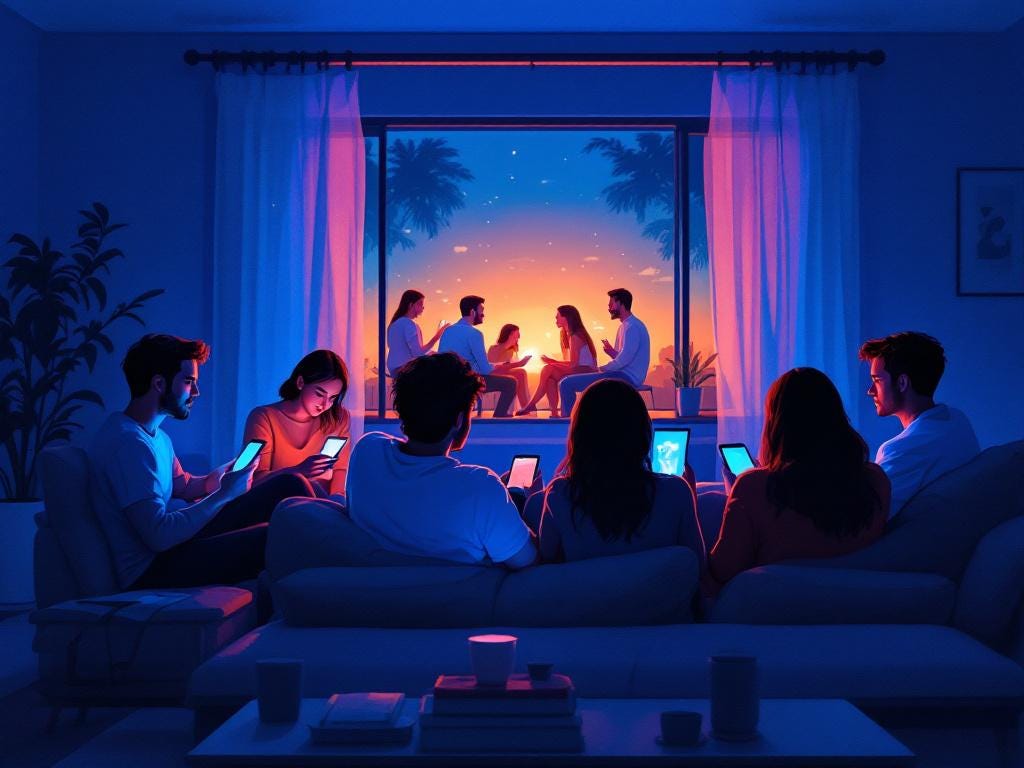
There are many, but one stands out changing our daily habits. We must reject the culture of excess and acknowledge that our resources money, time, patience, our own lives and planet are finite. Convenience, if left unchecked, will be our downfall. The “lone leader” mentality fractures even families. Each member retreats into their own digital world, absorbed in personal devices and self-centred values. Shared knowledge and experiences within families are fading each person is now in their own corner.
We’ve lost our sense of community, only coming together when things go wrong. Not all is lost, but the majority still prefer to binge stream than to step outside and fight for their rights.
To the point that a few, or even this new generation, are unaware of socialising, receiving feedback, or using critical thinking. Mostly because they never had to. Emojis distil and erase meaning, most don’t know how to confront issues when things go wrong. It’s easy to be online, punch harsh words at others, and expect no consequences.
And this is also a symptom of certain parents, that use words, like: “you are fantastic”, “that is so amazing”, “you are a super heroe”, these are all empty vain feedback, although with the best intentions, but doesn’t mean nothing besides bringing a smile that is shattered once the person of received such hyper praises, realises that there’s nothing amazing, fantastic on her/his actions.
When you spend too much attention on a phone, you don’t notice what’s happening around you. When you spend too much time on a smartphone, you’re absorbed into a realm that says “yes” to any desire.
We see wars from a distance.
We see starving people from afar. We see harassment on the public transportation, but we ignore it or hide behind our phones.
We accept bullying at work as normal.
We’ve been desensitised to things that, 100 years ago, would have sparked revolt.
We cannot continue like this.
The web is not an ad, a place where we’re constantly attacked by “buy this,” “buy that,” “use this,” “become that.” Children are now confused about who they are, with 50 plus “genders” on their favourite platforms. They’re bullied, attacked online, and most don’t know how to cope. Why? Because we forgot about communities. Parents have forgotten how to protect their kids. Instead, they say, “Don’t bother me now go play on your phone.” Now, people with questionable morals are teaching our kids what to follow and how to view the world.
The web has become an environment where grabbing your attention isn’t enough. It must change your perception, reduce you to a dataset a consumer feeding without knowing.
Turn your leadership skills into a blind follower, with no hope than to accept.
How can we grow the next generation of leaders if they can’t think for themselves? If their moral compass is built on exaggeration, deceit, delusion, and “fake it till you make it”?
We’ve lost our sense of community because most of us see each other as competitors or enemies. We’re quick to judge, believing our memories are factual and correct.
As a community, people used to stop what they were doing and be together. Back in the day, they’d go to concerts to enjoy, dance, and meet others. Now, we’re behind phone cameras, showing others how much fun, they’re missing. Is being a bystander fun?
We’ve put ourselves second, letting camera filters decide what we see, erasing facts, and turning real moments into visual adultery. We’ve embraced fakeness all because we want our singular experience to be better than anyone else’s. “Look at us, click me, like me.”
The need for attention has pulled us out of community into a fashion-like-showcase.
Maybe we should rethink our relationship with online presence, technology and the web what it means to us and its impact. Not because of the technology, but because of who decides how it should be used.
Our examples are wrong the people we adore are wrong. Having billions doesn’t mean you embody the best of humanity.
If we want change, we must embrace finding ourselves, reaching for community, practicing respect, and shared humility. And be more considerate of our actions.
True we look for the “single heroes” to be our lighthouse, to tell us what it is. But even they are alone today, risking themselves while the majority hides in the comfort of convenience, they need us and we need them, and each one of us required each other to go forward. Is not a lonely journey.
Wars weren’t won by a single hero but by countless heroes who gave their lives for a better future not to sit down, hunched over a phone, letting evil people get away with it, laughing in our faces, and sucking every last drop of dignity and resource we have. And call it progress, innovation.
I once believe that I could not live with certain online services, but with some simple actions, like supress notifications, uninstall apps from the phone and use more my laptop to access it. Made my choice more effective, since I cannot carry a laptop everywhere when I do must be for a reason.
And hold and behold it’s like I have never need it.
The concept of communities, comes from protection, being a part of something, belonging, accepted. Big tech companies compete not only for our attention, but for our place in the community, for our potential as leaders. If we let ourselves be led by their applications, you will lose yourself, but an educated citizen/person. Knows the pros and cons of using online platforms. And it knows that are times you are there and most of the time you are in community.
Communities are built.
It requires effort, declining things we know in the long term will impact us negatively, like staring too much to a screen, not speaking with other diverse opinions, not taking care of one mental and physical health. An app can’t motivate you, it will demand. Having a community is the de facto motivator. Personal growth doesn’t come from empty messages.
Communities are built on the human need for connection and a sense of belonging to something larger than oneself.
Sometimes I keep thinking that all this FOMO, fear itself, must come from some place in the past. And our ancestors lived in a place of fear. Fear of starvation, fear of predators, fear of the climate, fear of the unknown.
Is this fear of the unknown that block our vision, that keeps putting together control mechanisms in everything around us?
This belief could simply make us more united, social and make what we are today.
And today this fear is being exploited to the point we fear ourselves. We fear we are not enough, we don’t have enough, we need to prove ourselves to others, that we need a app, service, something to give us the edge. It took me 4 hours to write this post, including research, pauses, frustrations and more. But I made it. I know the fear of not having nothing to write is a scary one, that the seek for a shortcut to use a LLM to write my words is bigger and easier than before. But I know that just because is available doesn’t mean I should. Just because tobacco is out there doesn’t mean I should start smoke, and so on. We trough shared experiences acquire knowledge that keep us from making bad decisions. And although is make bad decisions all the time. Most of it is not pursue it due to community connections. People that advice you, care for you, that supports you.
And I decided to write and not use LLMs to generate content for me, when I started feeling that it was not me. I’m trying to share something personal to my community, why let a “thing” determine what, how, and when I should write.
And this is not against innovation, or living on the past. Is seeing things for what it is. This “AI” LLMs chatbots, are not what we required. The technology can be applied on other ways. We hire people so they can showcase their expertise, we read others people writings, so we can get a glimpse of their experiences, we use technology to connect and express our ideas and more. But once you are on the passenger seat, there’s no much you can do to change the directions.
We are facing real problems today, that are affecting too many people around us, and sometimes a simple gesture of compassion, seeing others as part of a community, can help, and a lot.
It’s hard to make a change, to really put aside your phone, to not engage in certain social platforms, to not be there.
But imagine this, in real life, are you running up and down, trying to know what is happening in your street. Speaking with every person you meet? If you could imagine the way we use online platforms in real life, we would be exhausted, and possibly end up in the hospital.
But the problem is that we do all this and more, from our chairs, we don’t feel the negatives impact, until off course when depression and others mental stress. And when that happens, you collapse. There’s no Reddit, X, Facebook, LinkedIn that magically will materialise itself and hold you an hand. It will continue to do its work, which is provoke engagement. Is the people around you, your community that will support you either you wanted or not?
Shared leadership mostly happen with connections, accepting others as leaders as well. It’s not hard, we have just been conditioned that one must control others and better divided than together.
Our mere existence cannot be, liking posts and notes, following, checking this and other, engaging endlessly just to entertain the algorithm, just to make sure the processes others put in place are moving. Life is much more than this.
I don’t fear technology, but the business models, the people behind it that time and over time are diminishing our communities and ourselves to fit their needs.
And maybe we should “vote” on companies, startups, governments that really put people first, and not just on paper.
About the Author
Tino Almeida is a tech leader, coach, and writer reshaping how we think about leadership in a burnout-driven world. With over 20 years at the intersection of engineering, DevOps, and team culture, he helps humans lead consciously from the inside out. When he’s not challenging outdated norms, he’s plotting how to make work more human one verb at a time.