

I’ve been in tech long enough to remember when we still used floppy disks and people genuinely thought Java applets would change the world.
But I’m not here to wax nostalgic about old tools.
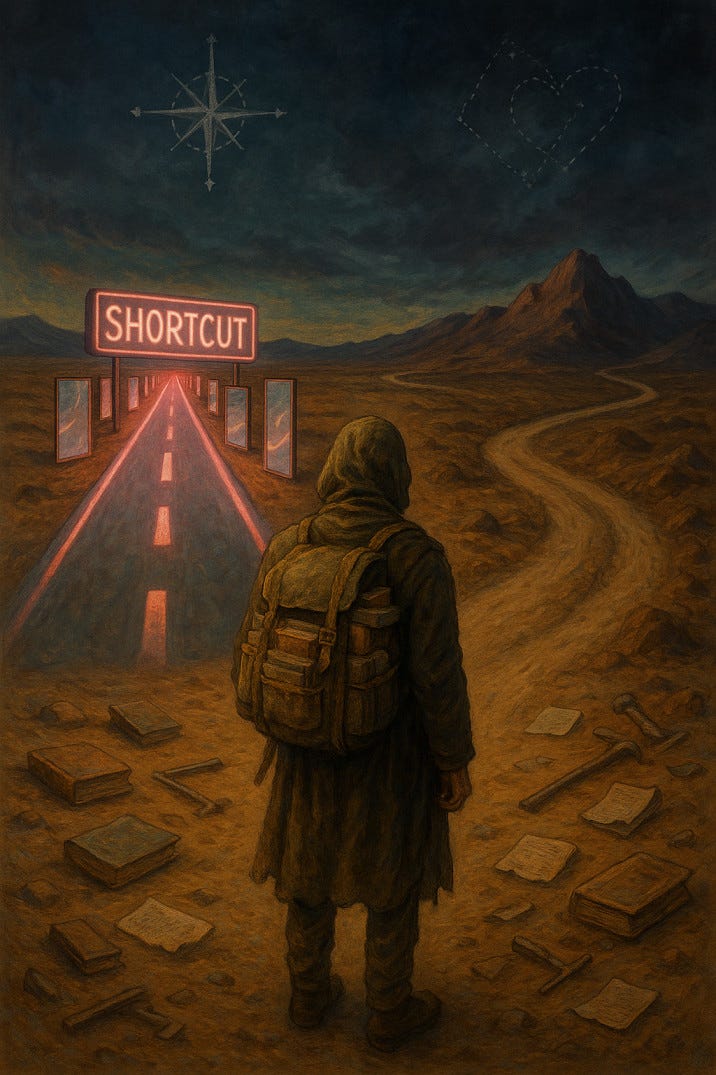
I want to talk about something that’s been sitting heavy on my chest for a while now something I keep seeing in the people I coach, the leaders I work with, and honestly, in myself too: this growing obsession with shortcuts. With fast growth, easy wins, pre-baked strategies, and AI that does the heavy thinking for us.
And I get it. Who doesn’t want the fast lane? When you’re overwhelmed, under pressure, or just plain exhausted, it’s tempting to reach for the template. The framework. The five-minute summary. The shiny new AI assistant that promises to “10x your output” or “replace your creative process” or some other nonsense.
But here’s the thing I can’t shake: the human brain wasn’t built for this kind of consumption.
It wasn’t built to learn from highlight reels and how-to threads and 2x-speed podcasts. It was built to learn by living through things. By stumbling, falling, getting up again. By building the thing, breaking the thing, fixing it — and maybe breaking it again.
We grow through friction. Through confusion. Through the kind of discomfort you can’t fast-forward through. The kind that makes you sit down with a drink and ask yourself, “What am I even doing here?”
I’ve learned more from failure than I ever did from a TED Talk
There’s a pitch I still remember from ten years ago — the kind where you put everything into it and walk out with your tail between your legs. I thought we had it. I believed in the idea. I still do. But it flopped. The silence in that boardroom was almost funny. Later that night, after licking my wounds, I rewrote the whole deck and asked myself some hard questions about what I’d missed.
There was a time I hired someone based on gut instinct. Super smart, on paper. Charming, confident. They blew things up in all the worst ways. It cost us time, trust, and team morale. That’s when I finally stopped treating values alignment like a box-tick exercise and started listening more deeply during interviews.
And of course, there are the late-night production outages. The ones where you're in Slack at 3am with bleary eyes and a racing heart. Those nights taught me more about shared ownership and psychological safety than any leadership book ever could.
None of these moments were efficient. They were messy, painful, human. But they were also the moments that actually changed me.
That’s what I mean when I say: the burn is the point.
You don’t forget the lessons that leave a mark.
We’ve confused exposure with understanding
There’s a kind of “content cosplay” happening everywhere now. It looks like learning. It smells like insight. But it’s hollow. A flood of people consuming wisdom without embodying it. Copying style without substance. Building personas that look impressive but don’t hold up under pressure.
I’m not immune. I’ve caught myself doing it, too — skimming when I should be reflecting. Generating when I should be grappling. “Brainstorming” with AI and calling it thinking.
The truth is, a tool can assist. It can accelerate. But it can’t integrate. It can’t feel. It can’t hold the nuance of your lived experience. It can’t wrestle with contradiction or sit with a moral dilemma. It can’t reflect on your childhood, your leadership failures, your hopes for your kids.
You can’t outsource that. And if you try, what you end up with isn’t growth — it’s a veneer. A shortcut to looking smart, not being wise.
The people selling you shortcuts don’t want you to go deep
This is the part that makes me angry.
So much of what passes for “advice” now is packaged to keep you addicted to surface-level engagement. It’s designed to give you just enough of a hit that you don’t look deeper. It tells you that you’re growing — while keeping you in a loop of comparison, urgency, and inadequacy.
I see people — brilliant, capable people — doubting themselves because they don’t have a personal “framework” for everything. Because their voice isn’t polished. Because they’re not churning out threads and thought-leadership posts like it’s a full-time job.
And I want to say this, clearly: those frameworks won’t make you wise.
They won’t teach you how to listen.
They won’t show you who you are when the stakes are high.
They won’t help you lead in the dark.
Only doing the thing, badly at first, will.
This isn’t about being anti-tech. It’s about staying human.
I use AI. I build with it. I coach people who are using it in amazing, responsible, creative ways. I’m not some Luddite screaming into the void.
But I’m deeply wary of anything that offers to do your thinking for you.
Because the thinking — the wrestling, the wandering, the uncertainty — is where the transformation lives.
If you hand that over, you don’t just lose the chance to be original.
You lose the process that might have made you whole.
This is bigger than productivity. It’s about meaning.
Most people I work with aren’t really trying to “do more.” They’re trying to feel something. They want to care again. To feel like their work matters. Like they matter.
But you don’t get that feeling from efficiency. You get it from depth. From presence. From fully showing up in the work — and allowing the work to shape you.
When you write the hard post, not because it’s viral, but because it’s true.
When you sit with the confusing brief and resist the urge to plug it into ChatGPT — not because it’s wrong, but because you need to go through the process.
When you teach someone else, and in doing so, see yourself more clearly.
That’s where meaning lives. Not in the hack, but in the habit. Not in the answer, but in the attention you give the question.
And look, I know the system isn’t on your side
We’re up against machines engineered to keep us scrolling. Platforms designed to fragment our attention. We live inside an ecosystem that benefits from our disconnection.
So yeah, the odds are stacked. But that’s exactly why this matters.
To slow down is an act of rebellion.
To go deep is a vote for your humanity.
To stay with something — to not outsource the discomfort — is how we remember who we are.
So what’s the alternative?
Not a new system. Not a better app.
Just this:
Take your time.
Be present with the things you’re learning.
Let yourself get confused.
Sit in the discomfort long enough for it to teach you something.
Stop pretending you can skip the part that matters.
And when you feel the pull toward the shortcut — the life hack, the framework, the three-bullet answer — pause.
Ask yourself:
What process am I avoiding right now?
What might I gain by staying with it just a little longer?
Who do I become if I choose the slow, messy, honest path instead?
Because in a world where we can simulate almost everything…
…the only thing we can’t fake is the insight that comes from actually living the experience.
From failing, and still showing up.
From doing the work, and letting it change us.
That part the real, human part is not something you can download.
And it’s never wasted.
About the Author
Tino Almeida is a tech leader, coach, and writer reshaping how we think about leadership in a burnout-driven world. With over 20 years at the intersection of engineering, DevOps, and team culture, he helps humans lead consciously—from the inside out. When he’s not challenging outdated norms, he’s plotting how to make work more human—one verb at a time.