

The recent buzz about Meta’s reported $100 million offers to engineers from OpenAI isn’t just tech gossip.
It reveals something deeper about leadership styles and what really drives these giants as they race to shape or control the future of AI. Something that concerns all of us.
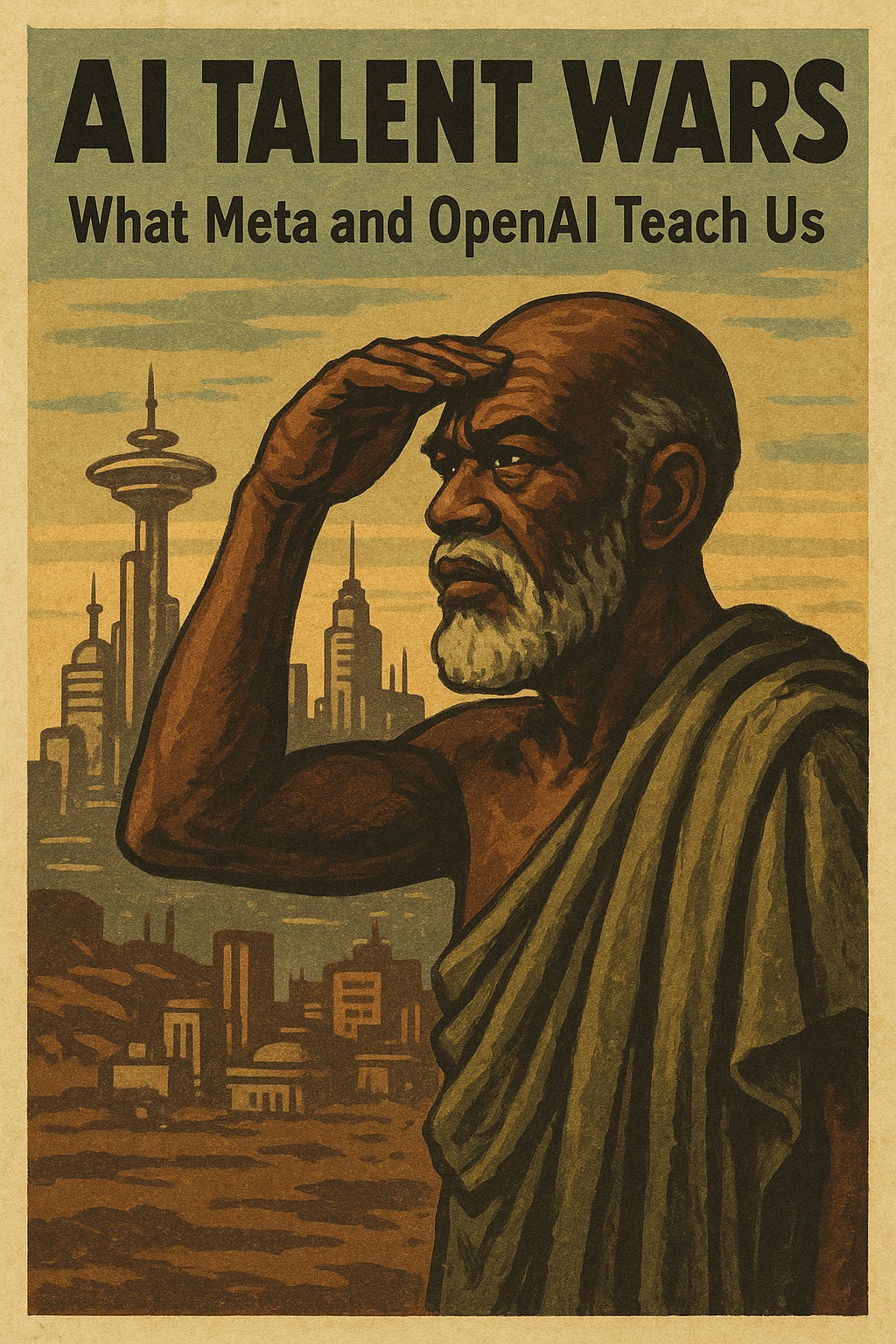
Possibly the FOMO, since they are sustained by it and make us FOMO adopters, if they lose such race, they are no longer part of the FOMO and will become old news, like MySpace.
Or simply they, in this case Meta, believes in the Solo Hero, imagine how many capable engineers they could hire, that would contribute with more insights and diversity?
Meta’s playbook feels very clear, compete hard, spend big, move fast. Their aggressive hiring and layoff spree and the creation of “Superintelligence Labs” scream top-down, resource-heavy leadership.
It’s all about scale, dominance, and rapid growth betting everything on snagging the best talent by any means necessary.
And I can’t help but wonder what that means for the people already there. If you’re on the team, does that mean your salary gets a bump too? Or are you just a number until you get poached?
This kind of approach has power. It can spark breakthroughs and shake up entire industries.
But it also risks something crucial: when the focus centers on compensation and external hires, internal trust can crack, team spirit can fray, and the deeper purpose behind innovation can get lost.
It makes me question if there’s much leadership in that or if it’s just a scramble to avoid being last or to build a company that truly values its people.
On the flip side, OpenAI’s leadership shows something different. It feels more mission-driven, relational, rooted in shared purpose and community. When Sam Altman talks about feeling “as if someone has broken into our home,” it’s a sign of leadership that deeply values people not just as employees, but as collaborators on a collective journey.
But contradict itself by saying “AI is already replacing entry-level hiring at some Big Tech companies.”
That kind of leadership sends a message: loyalty, stewardship, long-term vision. Sure, it’s vulnerable in a hyper-competitive world, especially up against giants with deep pockets like Meta.
But it keeps the mission front and center a mission to build safe, beneficial AI for all, at least in principle.
Both styles have their place. But the real question is, what kind of leadership do we want to drive the future?
Do we choose fierce competition and heavy spending?
Or do we lean into shared purpose, trust, and community resilience?
Or maybe something else entirely?
AI is reshaping companies and the world around us.
These contrasting leadership styles from Meta and OpenAI aren’t just about tech.
They send a much bigger message about what they are capable to truly control.
Who should be trusted to wield such powerful technology.
Diamantino Almeida
Leadership as a verb. Tech | Writer | People
'Move fast & break things' may lead to slower sober thoughts and then Policy enabling citizens controlling AI. After all, the current business model sucks and it's as Cory Doctorow characterizes it as "enshitification". AI is still just a 'tool' and big tech employees the tool makers. Human knowledge, experience and thought are the 'juice' in the AI tank - to use a physical analogy.