

The Toxic Mirage in tech leadership occurs when a team’s success is measured by "vanity metrics" (like PR volume or Jira velocity) that mask underlying burnout and technical debt. It creates an illusion of progress while the human and technical foundations of the company are actually eroding.
I truly believe there is something out there, beyond this realm not because it makes us important or validates our existence, but because we are part of something larger. Though the universe around us may seem lifeless, we have the privilege of witnessing it all with our eyes, souls, and minds.
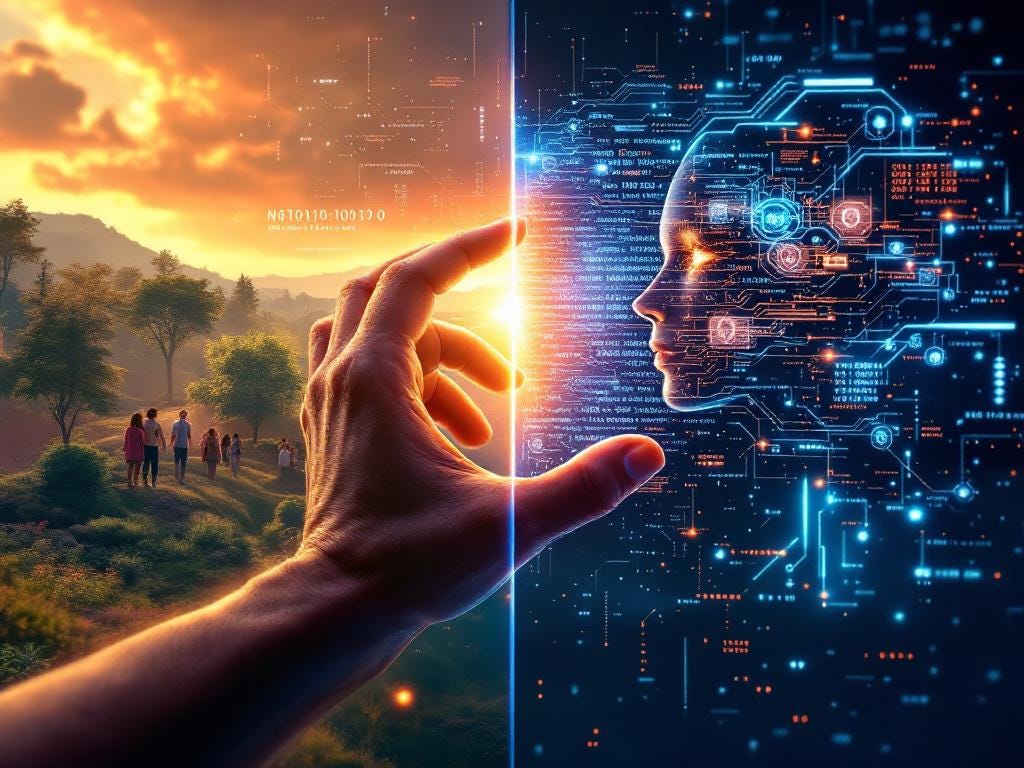
I don’t believe we are mere computational beings living in a simulation.
The idea that a “computer” could simulate an entire universe, us, or anything else strikes me as flawed thinking. Similar to the thinking about more compute, more artificial intelligence. This notion, in my opinion, comes from people who fear being out of control and justify their fears by insisting that everything can be controlled, computed, analized, and taken a part and sold.
The same goes for claims that LLMs are PhDs or rivals to humans. I find this narrative purposefully wrong and misleading. Yes, a human can’t compete with a tractor, but guess who designed it and who can rebuild it? People need to understand that replicating what we do in milliseconds is extremely difficult. Don’t confuse calculations for intelligence.
This AI narrative diminishes the human mind
And we’re accepting something so inferior that we’ll regret it when most of us realize what we’ve traded our freedom for.
As of October 2025, scientists have gone back to President of the European Commission to retract AI hype statement. And this is concerning, how our representatives are being fooled by technological institutions that are preying on our rights and make a profit out of it. Why aren’t we looking at our scientific community to see, and understand what this is all about. Why do we put so much trust in CEOs, that for countless times have shown us that they don’t care about us.
I see how powerful some companies have become, to the point that they seem to do whatever they want to get to their megalomaniac objectives. How we believe that our minds, the person we are, can be easily defined with simple bits and bytes, ones and zeros.
Sometimes, I think this AI narrative resembles a passive-aggressive narcissist one that initially charms its victims, only to diminish them to feed its own beliefs. When big tech leaders claim they’re “too big to fail” or that we have no choice but to accept their systems, that jobs will be lost, and is ok for people to be unhappy, it’s time for us to stop, think, and question why.
I can guarantee that all the trillions invested in tech until today would be enough to support initiatives to improve the lives of every human on this planet to help reduce our environmental impact and protect other species. And still maintain a dignified way of living.
We have the intellect to know and do what’s right and wrong, to help others and our environment. We can’t just extract resources and move on, leaving destruction in our wake.
That’s irresponsible.
It’s true that there’s something special about LLMs, especially because we can interact with them in our own language. But that’s where it ends. There’s no intelligence, inference, rational thought, or true understanding just matching and processing, like a factory sorting apple by size and color.
We are being fooled, but not because we’re stupid or naive.
It’s because the online environment today is toxic, exaggerated, unreal, and hyped a carefully crafted illusion. What we actually have is artificial illusion, artificial imitation, artificial ignorance.
Sometimes tech feels like a illusionist trick, promising and make us believe that all our problems are technological. We can fix polution in our environment by having more apps looking into it, solve poverty by dump data into LLMs and expect it to come up with a solution. That no matter what bad things are, technology will save us.
But it’s not, we protect ourselves, other species, even ourselves by changing our behavior, by thinking about our actions, by understanding that convenience has it’s perils and consequences. Just like we have become addicted to plastic, now we are being pushed to being addicted to let go of our rights, of our cognitive abilities, to our belief in ourselves.
We are becoming depended of something.
And soon, due to generative AI, we may no longer be able to distinguish fact from lies.
In a confuse world, is easy to run after those that promise to have the solution.
All because there’s money in it.
Wars make money.
Rebuilding makes even more and keeps affected areas and countries dependent on others, stripping them of sovereignty. It feels like a war on our minds: “You can’t compete without an LLM,” “You’ll be replaced if you don’t use it.” “AI is here and that’s it, nothing you can do.”
Being in a state of war, keep us not using our critical thinking more often and steer our attention to other things, like survival.
And this is the state most of us adopt now, surviving, following the next winning pattern.
Maybe it’s time to say we don’t need CEOs or corporations as they exist today.
Maybe we should all be stakeholders, deciding collectively what’s best for our shared future and CEOs and corporations would do their moral thing to ensure our lives are respected. (but again corporations exist to make money, it’s not a social initiative).
At its core, this is a fundamental issue, and we still have a choice.
Every time we buy fast food, we’re saying yes to harmful products and the pollution that comes with their packaging.
Every time we use an online LLM chatbot, we’re saying yes to wasted water, land, and increased pollution for those living nearby while reducing wages for the invisible data annotators who are the true builders of these systems.
Every time we act on impulse, we’re feeding algorithms that crave engagement, not truth.
Every time a child harms themselves due to social media or a chatbot, and we fail to demand regulation and accountability, we’re saying yes to an online world where human lives don’t matter.
Every time we delegate our tasks to subscriptions until we lose track of what’s happening and feel powerless when they fail, we’re saying yes to dependency, irrelevance, and commercial captivity.
There is hope in us, and also in tech.
We are what we consume. We keep telling ourselves that tomorrow, we’ll change only to realize we’re still trapped in the same cycle, passive, making excuses, blaming others for our inaction. Believing a piece of code is exactly what we need to move forward, it can help, but is on us, and to reach other people for help.
If you study history, like I do, you will suddenly realise that all those ancient cities there once were thriving with people, were simply abandon. Because people realised how harmful that environment was. How the elite became crazy. Sometimes we need to question ourselves if this is exactly what we want for us and for our kids.
A leader doesn’t need a fancy suit,
Billions in their pocket, magazine features, or podcast appearances. Yes, these can help spread ideas and values, but true leadership is about what you stand for, your moral compass, not what you possess.
It’s about putting yourself in others shoes, and for those that don’t have shoes to help/teach them how to obtain/create it. It’s about being accountable, responsible, looking ahead, evolving others in decisions, being humble and make thought choices.
Being a leader is not easy.
We are in this together, is a finite planet, what you do will definitely impact someone else.
It’s a trap
The more you have the more you want, and I imagine that most billionaires suffer from some mental problem, the need to have more than others, and live forever…
Technology allows us to reach almost anywhere at any time. But we’ve forgotten that for our messages to travel, many people worked tirelessly and creatively to build what we now call the internet (the infrastructure) and the web (where sites and services live). It took collaboration, shared understanding, commitment, and ideals to get us here.
The web isn’t a default human right.
It’s just a tool, one that mimics a living brain but has no conscience, no life, no ability to make real decisions. It’s about processing and transmitting bits and bytes at the speed of light an illusion of instant connection. A tool possible from the post-war, from the desire of how to communicate in times of struggle, disaster.
I look at it now and see a reflection of the human mind, our fears and desires, codified , residing on empty pods, waiting for a click, a response, a call to initiate connectivity.
And also a desire to understand what else can we do with this.
Every choice we focus on, soon become material, into this world we call reality.
Many people believe you and I are simple vessels, mere organic code, and if that’s true, then digital entities could theoretically become like us. This presents a profound philosophical challenge.
We ourselves are made of organic material atoms that form amino acids, molecules that somehow combined to bring us to life. Perhaps we are a cosmic accident, an inevitable result of the ever-changing universe?
But could we create life from inorganic components?
Imagine a solid steel body with a brain capable of processing almost anything at the speed of light, in parallel godlike powers, absolute knowledge.
Yet, the question remains. Is absolute knowledge the ultimate goal? Knowing the where, when, and how of every subatomic particle in the universe at any given moment? Would you become detached from this universe or remain a part of it? And if this were all there is, how miserable would it be to know everything? Nothing would change. No surprises. No mysteries. Just omniscience without meaning.
This seems to be the promise or threat of AI, or what Artificial General Intelligence (AGI) or superintelligence could become. But think about how you feel when you achieve something, those days, weeks, or years spent waiting for that unique, fleeting moment only for it to suddenly pass, leaving you with an emptiness.
To fill that void, you chase the next thing. We are never truly satisfied, and perhaps that’s because we live in a universe where possibilities are infinite, where knowing all probabilities is impossible.
And when you use a tool to determine what you can predict on your own, you become a passenger…
There’s always something new.
And honestly? I prefer this uncertainty. I’d rather feed my curiosity than settle for the eternal boredom of omniscience not the mindfulness of presence, but the despair of having nothing left to discover, no “next thing” to pursue. Ignorance, in this sense, is a gift.
We have a choice. The question is.
What will we do with it?
To escape the Toxic Mirage, you must start building Humane Architecture systems designed for humans, not just for spreadsheets.
About the Author
Tino Almeida is a tech leader, coach, and writer reshaping how we think about leadership in a burnout-driven world. With over 20 years at the intersection of engineering, DevOps, and team culture, he helps humans lead consciously from the inside out. When he’s not challenging outdated norms, he’s plotting how to make work more human one verb at a time.
Like Gary Marcus well said, in this article: https://garymarcus.substack.com/p/if-you-thought-the-2008-bank-bailout
It feels like the cold war, where fear will determine the fate of a generation, because a few are too selfish to let it go.
Diamantino Almeida’s reflection reads like a soul searching for clarity in a world that’s spinning too fast. It’s not just a critique of technology it’s a deeply human plea to remember who we are beneath the noise. His words carry the weight of someone who’s felt the seduction of progress, but also its emptiness. He doesn’t reject innovation; he questions the cost of chasing it blindly. There’s tenderness in his concern for the planet, for the forgotten workers, for the children lost in digital illusions. He reminds us that leadership isn’t about power it’s about presence, empathy, and responsibility. This isn’t a rant. It’s a quiet, aching call to wake up, to choose meaning over momentum, and to build a future where humanity isn’t just a footnote in a tech manual.