
A hero within many faces
Be one too.

I love hero’s journey-type movies, Dune, Star Wars, Black Panther, The Matrix, and so many others.
Joseph Campbell author of “The Hero with A Thousand Faces” wrote about this beautifully, although is eurocentrist view with sparse or superficial references to African traditions among others, reflects a outdated anthropological worldview, typical of many Western scholars in the early-to-mid 20th century.
They grip us so easily because they tap into something deep, something primal.
These stories give us a single figure to focus all our emotions on. They carry our fears, our hopes, our rage, our longing. And when that hero achieves their goal defeating the empire, awakening to their power, reclaiming their throne we feel it in our bones. We’re released from something we didn’t even realise we were holding. It’s a kind of emotional alchemy. A mythic therapy.
The structure of these stories is famously clear and satisfying. Joseph Campbell called it the "monomyth" a pattern that stretches across cultures and eras. There’s a call to adventure, a departure from the familiar, trials and enemies, a descent into darkness, a transformation, and a triumphant return.
It’s easy to follow, easy to remember. It maps neatly onto our lives, or at least our desire to make sense of them.
But while I find these stories powerful, I’ve also started to question what they leave out.
There’s something almost hypnotic about watching one person become “the one.”
One chosen leader, one voice, one path forward. That focus is comforting. But it also narrows our imagination. It trains us to look up to one figure, to wait for the arrival of someone stronger, smarter, more enlightened to show us the way. It conditions us to think leadership is about being the hero when, in reality, leadership often looks very different.
And when we over-identify with the lone hero myth, we risk missing the deeper magic: the fact that transformation, survival, and progress often come from many faces not just one.
Take El Eternauta, the Argentine graphic novel masterpiece.
It’s not as globally well-known as Star Wars or The Matrix, but it offers something deeply important: a vision of collective heroism. In El Eternauta, the main character Juan Salvo isn’t a superhuman warrior or a destined messiah. He’s a regular man surviving a global catastrophe alongside his family, friends, and neighbours.
The story doesn’t centre on him as “the one” who saves the day it shows that anyone can take the lead, depending on the moment, the need, or the crisis.
That idea that the hero can emerge from many faces isn’t actually new. It’s buried inside a lot of the classics we admire.
In Star Wars, yes, Luke has the arc. But without Leia’s political clarity, Han’s grit, Obi-Wan’s wisdom, and the sheer bravery of everyday rebels, Luke’s mission would’ve failed before it began.
In The Matrix, Neo is “the One,” but Morpheus is the believer who finds him, and Trinity is the anchor who holds him together. In The Lord of the Rings, Frodo carries the ring, but Samwise carries Frodo often literally when he’s too weak to go on.
In each of these stories, there are people behind the hero. Not just helping, but often leading in ways the hero cannot. These characters aren't just sidekicks they're co-leaders. They’re the ones who hold space, fix problems, question choices, and sometimes make the critical moves themselves. They are the many faces of leadership, of courage, of agency.
And yet, we still focus on the one. Why?
Because it’s easier. It’s cleaner. The myth of the single hero gives us a sense of order in a chaotic world. It gives us someone to praise or someone to blame. It lets us believe in simple causality: that one person, in the right moment, can change everything. It lets us distance ourselves from responsibility and from our own potential to lead, shape, or act.
But the real world doesn’t work like that.
Leadership isn’t a clean arc. It doesn’t always come with a glowing sword or a chosen prophecy. It’s messy, fluid, often invisible. Sometimes it looks like stepping up to speak truth to power. Sometimes it’s staying back to hold the emotional weight others can’t carry. Sometimes it’s logistical. Sometimes it’s spiritual. And often, it’s shared.
In reality, leadership doesn’t come from a single hero at the front of the room it emerges through the relationships between us. It’s organic. It’s distributed. And yes, that makes it harder to follow. It’s enveloped in multiple layers of significance. It doesn’t fit neatly into a three-act structure. But it’s real. And it’s equally important.
Nature shows us this constantly.
Ecosystems survive not because one species dominates, but because of interdependence. In a healthy forest, trees share resources underground through networks of fungi. Leadership, in that context, isn’t
about control or centralisation it’s about support, adaptability, and response. It’s about survival as a collective act.
The same is true for communities, teams, movements. We move forward not because one person has all the answers, but because many people contribute what they can, when they can. Leadership might look different in each face but each role matters.
That’s why I believe we need to rethink our addiction to the lone hero myth. We can still admire it. There’s still wisdom in those journeys. But we also need to cultivate stories and systems that reflect a broader truth:
There is a hero within many faces.
This isn’t just about representation. It’s about possibility. When we flatten heroism into a single type of character usually male, often white, often gifted or chosen we erase the multitude of ways people lead and show up. We lose the stories of care, collaboration, and resilience that don’t make the poster but shape the outcome.
The truth is: we are all different, and we are all equally capable. Capable of leading. Capable of transforming. Capable of sustaining each other when the road gets hard.
We see this when teams step up during crises without waiting for instructions. We see it when friends support each other through grief. We see it when movements grow not around a single figurehead but through decentralized, collective action.
And I think we need more stories that reflect that.
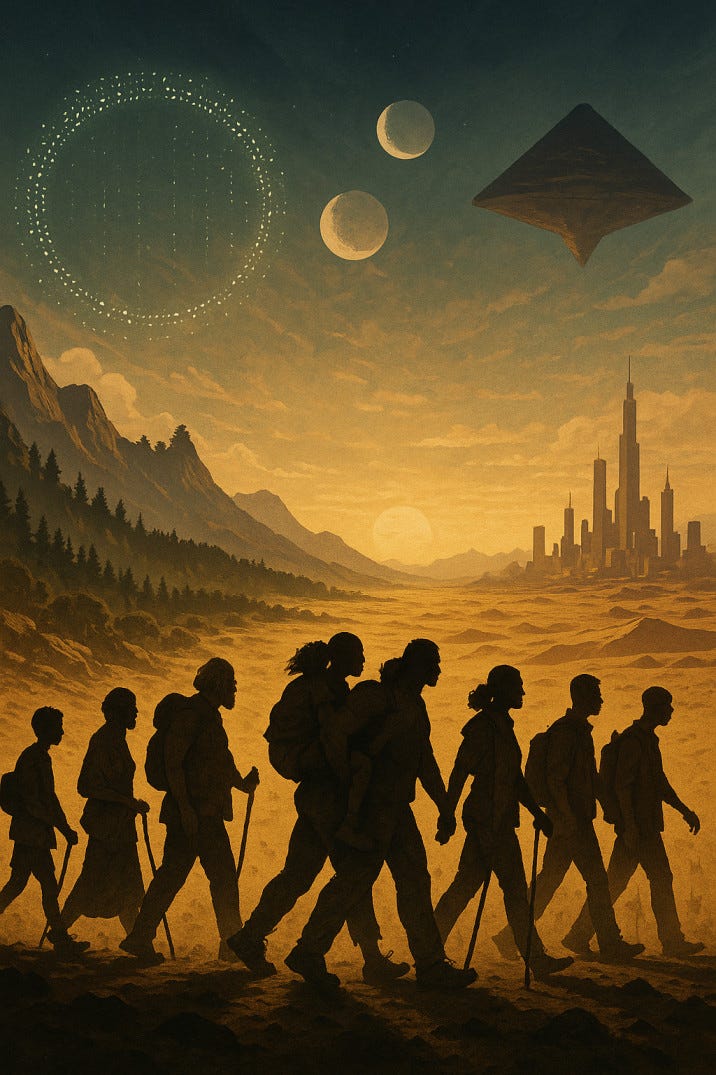
Not just stories of “the one,” but stories of “the many.” Stories where the hero is not a person, but a process. A movement. A network of people doing their best in impossible situations.
Imagine if we raised our children not to wait for someone to save them but to look around and ask, “Where can I lead today?”
Imagine if workplaces rewarded not just the loudest voice in the room but the one who quietly builds trust and brings others along. Imagine if we saw power not as something to possess but something to share.
This is not an easy shift. It goes against decades of storytelling patterns, corporate structures, and cultural conditioning. But it’s necessary. Especially now.
We’re living in a time of overlapping crises. Climate, inequality, misinformation, burnout. No single hero is coming to fix this. No app, no billionaire, no charismatic visionary will be enough.
What we need is a generation of people everyday people willing to see the hero in themselves and in each other. Willing to lead from where they are. Willing to trust that leadership doesn’t always look like a spotlight.
Sometimes it looks like showing up. Sometimes it looks like listening. Sometimes it looks like letting others lead.
That’s the deeper lesson I’ve learned from the stories I used to love so simply. The hero’s journey still speaks to me but now, I see it as one thread in a much larger tapestry.
A tapestry woven by many hands, many voices, many hearts.
So yes, be the hero if you must. Follow the call, rise to the challenge, take the leap.
But also look around.
Notice the others walking beside you. Notice the quieter arcs. The shared burdens. The unexpected guides.
Because in the end, the journey isn’t just about the one who saves the world.
It’s about the many who sustain it.
There is a hero within many faces.
Be one too.
About the Author
Tino Almeida is a tech leader, coach, and writer reshaping how we think about leadership in a burnout-driven world. With over 20 years at the intersection of engineering, DevOps, and team culture, he helps humans lead consciously from the inside out. When he’s not challenging outdated norms, he’s plotting how to make work more human, one verb at a time.