

Early work not representative of current direction.
It was 2003, and we were at a team meeting.
It was an urgent one not much explanation, apart from the email saying we needed to be in the meeting room near our pods at 6 p.m. It must have been summer, since I remember it was a very hot day. I was nervous even before the meeting started the suspense and lack of additional info were nerve-racking.
We all got into the room and waited for our line manager. He appeared, opened his laptop, connected it to the wall screen, and started showing some metrics how good we were doing and how our KPIs were improving.
Then came the news: our team leader was leaving, and a new one needed to replace him.
We started looking at each other. Some people said, “Tino, you’ll be our next team leader.” I got mad nervous and just nodded, signalling, “That’ll never happen.”
Then our line manager said this:
“Tino, you will be the team leader. I’ve spoken with many people, including your colleagues, and they all confirmed you’re the right person for the job. The way you treat people here is exemplary, and your performance metrics are off the charts.”
After that, I stopped listening. My heart was pounding in my ears. And then I had this urge to say something I completely forgot what it was but I know I shouted it.
Most people told me to lower my voice and giggled a bit.
I felt ashamed.
After that, I went home and couldn’t sleep, replaying in my head what I needed to do and what my life was about to become.
But one thing kept pinging in my head, “Why I’m breathing so fast?”
I didn’t truly begin to understand leadership until I started noticing how I breathed.
Not in some poetic, romanticised way, but in the deeply physical sense. The way my breath would get tight before a difficult conversation.
The way my shoulders would creep up during conflict.
The way I’d clench my jaw in meetings without realising.
For years, I led teams, coached others, built roadmaps, and helped solve organisational dysfunctions all while my own nervous system was on high alert, operating from a place of subtle but constant stress. I thought I was being “professional,” “focused,” or “productive.”
What I was really doing was pushing through, dissociating, masking discomfort until my body could no longer ignore the signs.
What I’ve learned since is simple
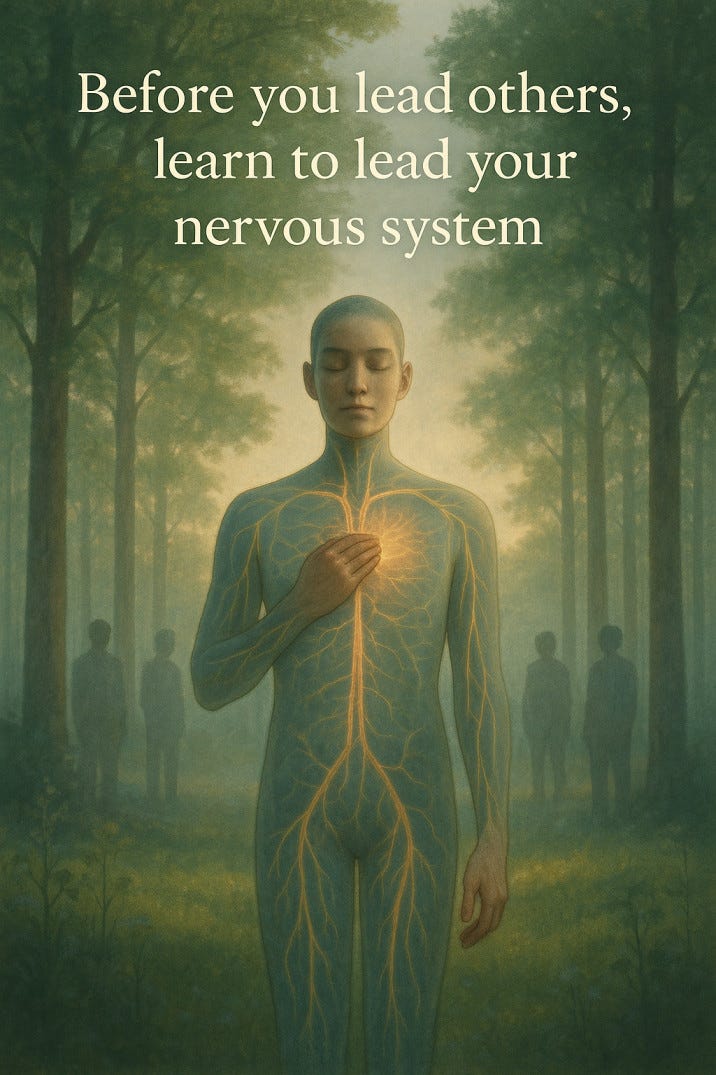
You cannot lead others effectively until you’ve learned to regulate and lead yourself especially your nervous system.
Leadership, at its core, is not a performance. It’s not a hat you put on in the morning. It’s not a set of bullet points in a quarterly update or a public talk-style declaration of your team’s values.
That’s the type of behavior or values expected at the corporate level, simply because companies exist to profit and results is what matters.
Should you value, listen, follow leaders that are at the corporate level?
Leadership begins in the body.
It shows up in how you enter a room, how you respond when someone challenges you, how you recover from mistakes, and how you make people feel not just with your words, but with your presence.
If your nervous system is constantly on edge reacting to threat, absorbing stress, masking anxiety that energy leaks out.
It creates ripple effects: tension, confusion, distrust. No matter how many management books you’ve read or frameworks you’ve implemented, if your body is signalling fear, urgency, or defensiveness, your team will pick up on that signal long before they hear what you have to say.
We don’t often talk about the nervous system in leadership circles.
We talk about mindset, tools, outcomes. But your nervous system is your first leadership tool. It governs your capacity to respond instead of react. It influences your tone, your timing, your level of presence.
I remember a few years ago in a “Leadership Workshop Sessions”, and after a session about “soft skills”, and respect your direct reports, most where saying,” what a lot of rubish”, “I don’t need to be polite, to get others to do the work”.
Most of us are taught to ignore or suppress our emotions to power through, be “rational,” stay calm. But here’s the paradox: emotional awareness isn’t weakness. It’s human connection.
Emotions are not the opposite of logic. They’re information about what matters to you, what you fear, and how you interpret your surroundings. If you can’t recognise what you're feeling or if you’re disconnected from how others feel you’re not operating from clarity. You’re leading from confusion and projection.
In my coaching work and leadership journey, I’ve come to understand that “knowing yourself” is not just a philosophical idea.
It’s a practical necessity.
You need to know your emotional patterns, your triggers, your inherited beliefs. You need to know what you tend to avoid, how you defend yourself when you feel small, what stories you’ve been told about power, success, and authority.
These internal patterns often run silently in the background until pressure hits. That’s when they emerge. In times of stress, you don’t rise to your ideals you fall to your level of nervous system training. If you haven’t done the work of knowing and regulating yourself, your leadership will default to instinctive reactions. You’ll either withdraw, dominate, appease, or distract often at the expense of your people and your values.
That’s why I believe emotional awareness and nervous system literacy should be core leadership skills not optional extras. These aren’t “soft skills” as they’re often dismissed.
They’re hard-earned, embodied capacities that determine how trustworthy, grounded, and stable you feel to others.
Teams don’t need perfect leaders. They need leaders who are present. That presence, however, isn’t magic it comes from regulation, reflection, and repair.
Let me say something else that’s rarely acknowledged: your nervous system is not isolated. It’s shaped by your environment. By who’s in the room. By the systems you work in. By the architecture of your calendar, the pressures of your role, the pace of your culture. A constantly overstimulated, performative, surveillance-based workplace will fry even the most emotionally intelligent leaders. That’s why slowing down, connecting with nature, unplugging from the noise these aren’t indulgences. They’re repair strategies.
The way I breathe in a forest is not the same as how I breathe on a deadline-packed Monday. My ability to think clearly, listen deeply, and act intentionally depends on how safe and spacious my environment feels.
The same is true for those I lead. Leadership, then, is not just about regulating yourself it’s about designing environments where others can regulate too.
When I think about what leadership is, I don’t think about status or charisma or metrics. I think about relational presence.
Leadership is relational work not individual conquest.
It’s not about commanding people into action. It’s about creating the conditions where people want to act, together. That requires deep listening, humility, co-regulation, and trust things that don’t come from titles.
They come from consistent human practice. In my view, leadership is something we do with others, not to them. And to lead well, we have to understand what our nervous system is doing in those shared spaces because it is always broadcasting something, even if we stay silent.
I’ve made enough leadership mistakes to know how easy it is to lead from fear especially fear masked as control, overwork, or perfectionism. I’ve been in rooms where everything looked fine on the surface and yet the team was walking on eggshells, waiting for someone to explode or withdraw.

I’ve also seen what happens when a leader takes the time to ground themselves, to pause before reacting, to acknowledge their own tension and come back to the conversation with openness.
That’s the kind of leadership I want to practise and teach.
So here’s my invitation: before you chase the next leadership framework or productivity hack, learn to sit with yourself. Learn to breathe when things get hard.
Learn to name what you’re feeling.
Learn to track the patterns that arise when you feel threatened.
Learn to regulate and not just react. Learn what brings you back to presence, what grounds you, what reminds you of who you are beneath the noise. Spend time in places that calm your body.
Listen to music that softens you. Walk in nature. Speak to people who challenge you without shaming you. Ask for help. Apologise when you need to. Slow down when you can. Not because it’s fashionable but because it’s necessary.
Because here’s the truth
The quality of your leadership is directly related to the quality of your presence.
And the quality of your presence depends on the health of your nervous system. You cannot fake groundedness. You either feel it or you don’t. And when you do, others feel it too. In your tone. In your timing. In your decisions. In your ability to listen without jumping in. In your capacity to hold complexity without collapsing.
I believe leadership is not about having all the answers. It’s about making space for the right questions to emerge. It’s not about being the hero.
It’s about helping others find their voice and act from it. It’s not about avoiding discomfort. It’s about staying with it long enough to find clarity. But none of that is possible if we’re constantly dysregulated, burnt out, or detached from our own inner signals.
How to Know and Regulate Your Emotions
Most of us weren’t taught emotional literacy. We were taught to bottle it, intellectualise it, or bury it under productivity. But leading your nervous system starts with feeling what’s there, not what you think should be there. Emotions are messengers not enemies.
Here’s how I’ve learned (and keep learning) to work with mine:
1. Name it to work with it
If you can’t name what you’re feeling, it owns you. Start simple. Angry. Anxious. Disappointed. Excited. Numb. Sometimes I sit with a pen and just write: “What’s alive in me right now?” And I wait. Just letting the nervous system speak through words.
2. Feel it in your body
Emotions don’t just live in the head they show up as heat in the face, tightness in the chest, butterflies, shallow breath. When something hits me, I ask: Where is it in my body? What does it want me to know? This helps create space between me and the feeling. It becomes something I can relate to, rather than be hijacked by.
3. Slow the hell down
Fast pace amplifies reactivity. When I’m triggered or overwhelmed, the first thing I try to do is pause. That might mean walking to another room, turning off notifications, or literally putting a hand on my chest. You can’t make grounded decisions in a state of panic and you don’t owe anyone a response at the speed of email.
4. Track your patterns over time
What tends to trigger you? What people, situations, or phrases light a fire in you or shut you down completely? Pattern tracking helps you anticipate rather than react. Sometimes the pattern isn’t about the moment it’s about an older story that’s never been questioned.
5. Breathe like your life depends on it (because it does)
When I don’t know what else to do, I breathe. Deep, intentional breaths signal safety to the nervous system. It doesn’t fix everything, but it gives me a fighting chance to respond with clarity instead of instinct. Box breathing. Long exhales. Breathing through the nose while walking. These aren’t hacks. They’re restoration.
6. Build your emotional vocabulary, slowly
Instead of just saying “I feel bad,” try: “I feel exposed,” “I feel dismissed,” “I feel hopeful but cautious.” Language helps precision. Precision helps clarity. Clarity leads to wiser choices. If you’re not sure where to start, keep a log. One emotion a day. One moment that moved you. Over time, you’ll surprise yourself with how emotionally fluent you become.
7. Create a few rituals that ground you
I don’t believe in silver bullets. But I do believe in small, repeatable acts that tell your nervous system: you are safe. That might be a cup of tea before meetings. A 10-minute walk at lunch. Music. Journaling. Gardening. Prayer. These things build emotional resilience not through grand gestures, but through consistency.
What science teaches us about emotions
If you are curious, here’s a bit of what I have experienced so far and learned.
The more I’ve learned about emotional regulation, the more I realise that this isn’t just a leadership tool it’s a survival skill. And science backs this up.
Our brains are wired for emotional response first, logic second. That’s not a flaw. It’s evolutionary design. The part of our brain responsible for emotional reactivity the amygdala is lightning-fast. It evolved to protect us from threats. The problem is that it can’t tell the difference between a tiger and a rude email, between a life-threatening danger and an awkward silence in a boardroom.
The emotional alarm system still fires.
But it’s the prefrontal cortex, sitting right behind your forehead that decides what to do with that emotional alarm. That’s where decision-making, impulse control, empathy, and long-term thinking live.
The prefrontal cortex doesn’t fully mature until around age 25, and even then, it continues to strengthen with reflection, feedback, and practice.
That’s important, because it means emotional maturity is something we grow into and something we can also regress from under stress.
When you’re tired, overwhelmed, or overstimulated, your brain literally reroutes to older, more reactive systems. The same thing happens when you’re constantly bombarded with alerts, polarising content, or high-pressure environments.
Your brain shifts from “consider and respond” to “react and survive.” And this is where technology and leadership power structures get interesting and frankly, concerning.
Because if you know that people are more reactive when they're scared, angry, or uncertain, you can design systems to keep them that way. And that’s what a lot of tech and media does. Social media platforms are engineered to exploit our limbic system to provoke outrage, anxiety, comparison, tribalism because those emotional states keep us hooked.
That’s how the attention economy works.
It’s not a glitch it’s the business model. The more dysregulated and distracted we are, the more predictable and profitable we become.
That’s why I don’t believe in passive consumption anymore. What you read, watch, listen to it shapes your nervous system. It conditions your sense of reality. If your feed is full of stress, urgency, or unattainable ideals, your body starts adapting to that reality. You start comparing yourself not to real humans, but to filtered performances. And the same thing happens with leadership. If all we see are polished, charismatic, never-wrong leaders, we begin to internalise that as the standard.
And we forget to look behind the performance.
This is why critical analysis of leadership matters especially now. We need to look beyond words. How does this leader handle conflict? Who benefits from their decisions? What kind of culture are they modelling? Are they willing to admit when they’re wrong or are they always positioning?
Do they speak with clarity and care or do they manufacture urgency to drive short-term action? These are not surface-level questions. They are diagnostic tools. Because if you can’t assess the emotional state behind leadership, you’re more likely to be manipulated by the performance of it.
I’ve seen this play out in tech leadership time and time again. Charismatic visionaries who talk about innovation but burn out entire teams. “People-first” CEOs who lay off thousands while posting about resilience.
Culture decks full of trust and empathy while the actual environment runs on fear, urgency, and control. And we applaud it because the metrics look good. Because the story sounds nice. Because we’ve been conditioned to think leadership is about style, not substance.
But if you really watch not just listen, but watch you can feel the nervous system underneath. And most of the time, it’s not grounded. It’s reactive, controlling, impatient, or disconnected. And that energy shapes everything beneath it.
This is also why your physical environment matters. You cannot regulate your emotions in a toxic space. If your workplace, home, or digital space constantly signals danger or urgency, your nervous system will adapt to that signal.
You’ll normalise tension. You’ll start bracing even when nothing’s wrong. And over time, that becomes your baseline. That’s why nature is so important to me.
Not just because it’s beautiful but because it reminds my body of a different rhythm. Slower. Quieter. More grounded.
You can’t rush a tree into blooming. You can’t schedule a mountain. When I spend time outside, something in me softens. My prefrontal cortex kicks back in.
I stop reacting, and I start remembering who I actually am not who I perform to be.
So this isn’t just about leadership in the workplace. It’s about leadership as a daily practice one that starts with regulating your own system so you’re not just reacting to fear, following trends, or outsourcing your moral compass. It’s about making space to ask: Is this real? Is this right? Is this mine to carry?
And that takes emotional maturity.
Which isn’t about having all the answers. It’s about being able to stay with discomfort without becoming someone you’re not.
It’s about being led by your values, not your triggers. And it’s about remembering especially in an age of endless performance that integrity is quiet. Often unseen. But always felt.
So before you lead others, start with yourself.
With your breath. Your body. Your emotions. Your blind spots. Your patterns. Because if you can lead yourself through discomfort without fleeing, fixing, or forcing then others will trust you to walk with them through theirs.
And that, to me, is the beginning of real leadership.
That’s leadership as a verb not something you are, but something you practise.
Especially when no one’s watching.
About the Author
Tino Almeida is a tech leader, coach, and writer reshaping how we think about leadership in a burnout-driven world. With over 20 years at the intersection of engineering, DevOps, and team culture, he helps humans lead consciously from the inside out. When he’s not challenging outdated norms, he’s plotting how to make work more human, one verb at a time.